

What is metal spinning | spin forming
Metal spinning is a metal working process that can make a metal disc or sheet deform different shape of revolving body in a spinning lathe or machine. The clamp press the blank sheet on the mandrel, The spindle rotates together with the mold and the blank and then the tail-top is driven to rotate. When the spinning roller touch and press the sheet according to the spinning path, the sheet will produce plastic deformation from the point to the line follow the spinning roller.
Metal spinning

1. The characteristics of metal spinning
Spinning metal is a process that integrates the characteristics of metal pressure processing such as extrusion, stamping and deep drawing, ring rolling, bending, and rolling.
● The deformation area is small, the deformation capacity is low, and the unit pressure is high.
● After spinning, the metal fibers are continuous and complete, the grains are refined, and the mechanical properties are improved.
● Multiple processes such as forming, trimming, flanging and flanging can be completed simultaneously in the same mold.
2. Advantage
● Cheaper mold and material
Metal spinning is a necessary metal forming ways in the manufacturing, Compare to other metal forming ways such as hydraulic forming and water expansion, the metal spinning mold (mandrel) is cheaper and simpler, compare other machining process such as CNC turning, it form a circular metal sheet into various shapes without removing materials from the workpiece,the materials cost is the cheaper.
● Higher tensile strength and hardness
Most of all, metal spun products have better tensile strength, hardness, tolerance after pressing and shearing by spinning roller, it can be endured the worst working environment. A famous Japanese company have been tested the same thickness, material and shape of part that is respectively made by metal spinning, deep drawing, CNC Turing. When put these parts in a specified working environment that endured the torque and high temperature, the deep drawing and CNC turning part will can't work after losing 60 percent of of the original accuracy and tensile strength after 8 hours, but the metal spinning products just lost 10 percent of its accuracy and tensile strength, it still can work availably. This is why the aerospace and special equipment industries choose the metal spinning to process the part.

3. Disdvantages
The production efficiency of spinning is not very high, and the processing cost is relatively high. It is suitable for the production of medium and small batch orders.
Working principle
1. Ceramic forming
The forming principle of spinning is very similar to that of ceramic technology.
Spindle take the blank to rotate, the roller pull and press the blank to form different shape according to the movement path of the roller. the function of spinning roller is equivalent to the hands of making ceramic.

2. Spin forming principle
● Metal spinning spiral line
During the spinning forming process, the spindle and tailstock drive the workpiece to rotate. The roller is driven synchronously by the X-axis and Z-axis, extrudes and stretches the workpiece along the predetermined route.
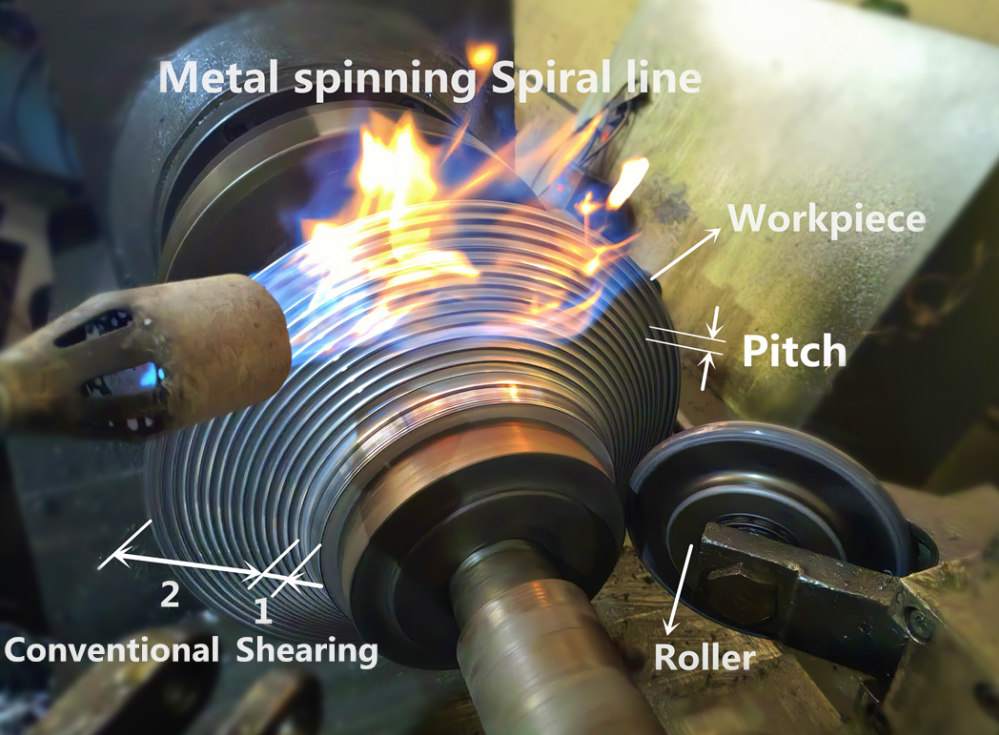
The relative movement between the roller and the workpiece will form a spiral line. The pitch of spiral line is wider, The less bending and stretching is subjected by roller on the per unit area of the blank. Reducing spindle speed and increasing feed speed can reduce the width of pitch.
● Classification of spinning roller path
We can simply divide the roller path into two sections in the workpiece.
▷ Workpiece touch mold
In the first section, the workpiece has already wrapped around the mold. The squeezing and pulling forces of the roller and the mandrel cause the workpiece to undergo shearing and tensile deformation. This is shearing spinning section.
▷ Workpiece haven't touch mold
In the second section , the workpiece does not come into touched with the mold. The workpiece only receives the pulling force from the tool wheel and only undergoes tensile deformation. This is conventional spinning section.
● Pitch
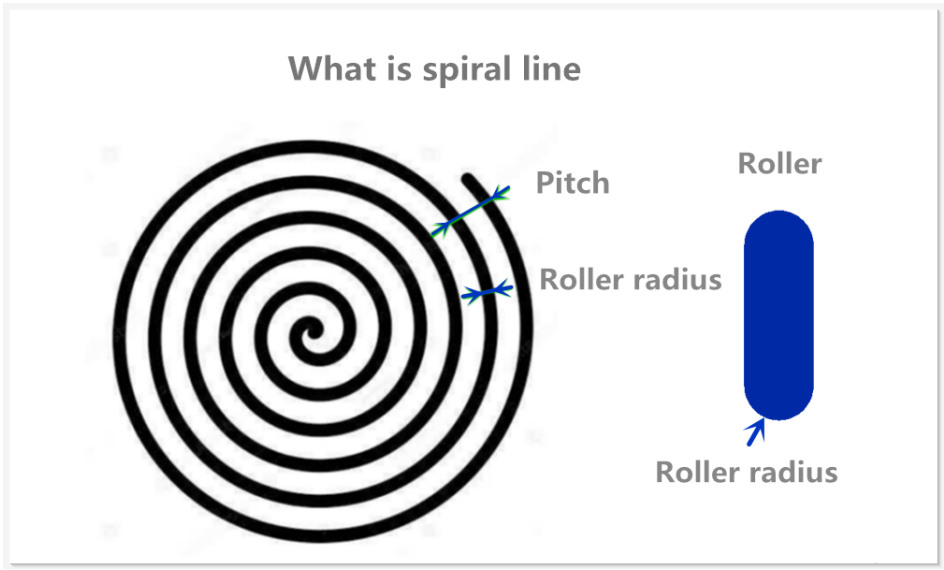
Pitch refers to the axial distance between two adjacent threads on a thread at the corresponding two points on the center diameter line, and it is an important parameter for measuring the density of the thread. In simple terms, it is the distance that the thread moves forward along the axis when it rotates one full circle.
● What is spiral line
Every spinning path is a spiral line,the pitch is effected by spindle speed and feed speed. The roller radius effect the depth of the depth of the spiral.
3. Spinning deformation force
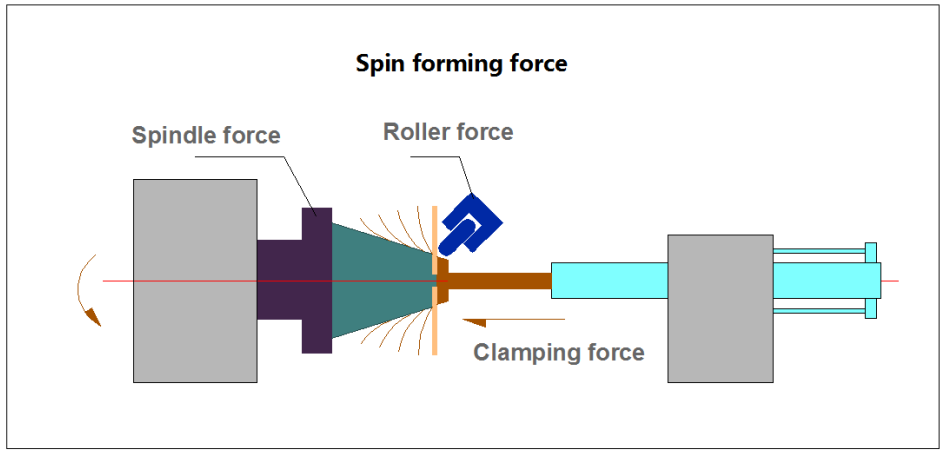
● Clamping force of tailstock
It is outputed by air pressure or hydraulic cylinder of tailstock, the friction force of clamp can make the sheet turn follow the spindle.
● Turning force of spindle
It is outputed by spinndle motor and take metal sheet to turn.
● Pressing and pulling force of roller
It is outputed by X-axis and Z-axis motor, when roller touch the workpiece, the touching point will pulled and pressed by roller according to the spinning path.
Spinning classification
1. Material deformation
● Conventional Spinning
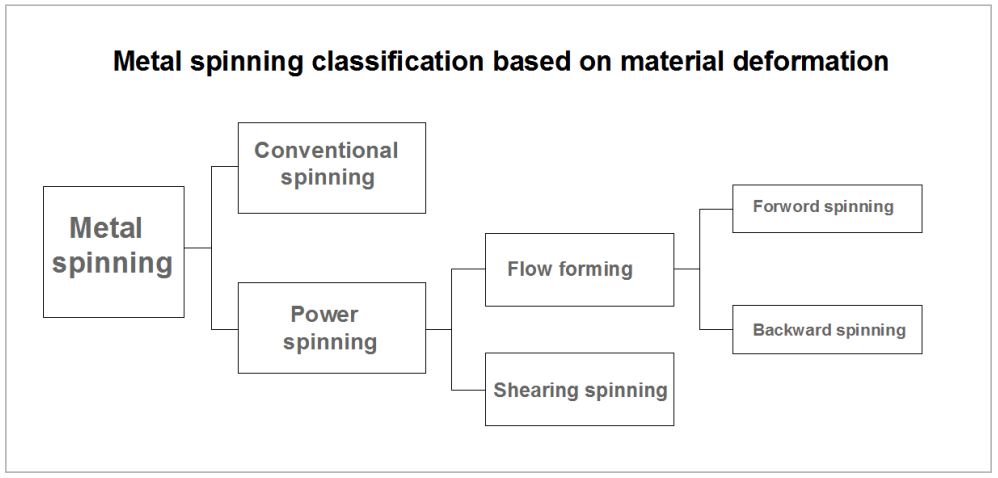
▷ Feature : It mainly alters the shape of the blank, such as the contraction or expansion of the diameter, while the wall thickness remains basically unchanged or undergoes only minor changes.
▷ Applicable scenarios : It is suitable for processing simple rotary parts such as cylindrical, conical and hemispherical ones, and is widely used in civilian fields, such as lampshades, aluminum buckets, tableware, etc.
● Power Spinning
▷ Feature : it significantly reduces its wall thickness While changing the shape of the blank , which belongs to thinning spinning. The material volume remains unchanged, and the thinned part is transformed into axial extension.
▷ Application scenarios : It is used for thin-walled rotary parts with high precision and high strength, and is widely applied in aerospace, missile casings, rocket fuel tanks, pressure vessels and other fields.
● Conventional vs power spinning
| Spinning | Conventional | Power |
|
Thinning |
Less | More |
| Mold | Materias touch mold | Materials haven’t touched mold |
| Roller force | Tensile force | Extrusion force |
| Grain change | Lengthen | Smaller |
● Flow forming VS shearing spinning
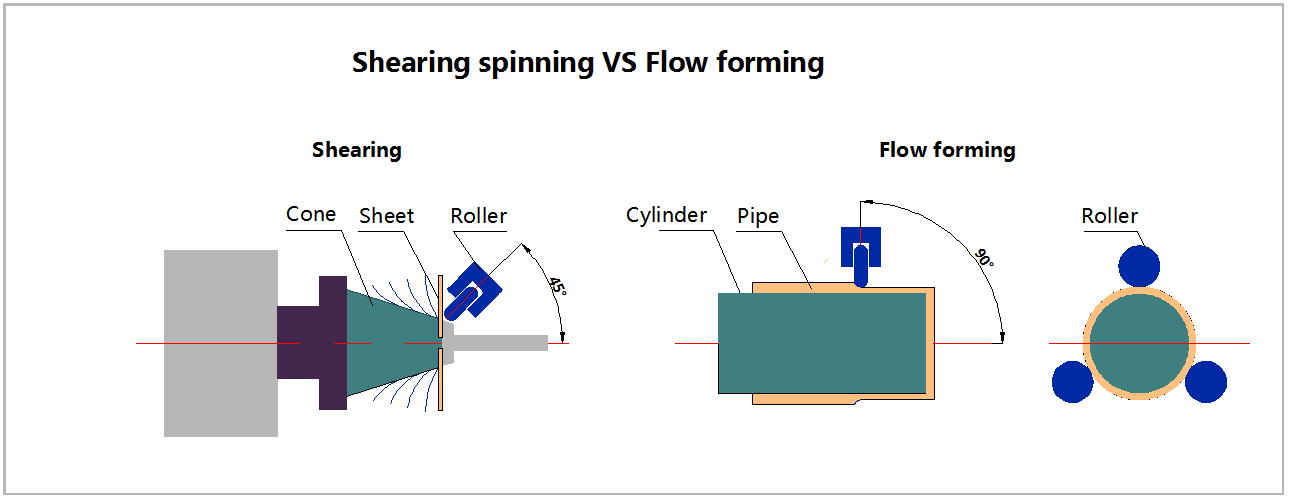
The thinning rate of shearing and spinning will be very high, The thinning rate of power spinning is 30% to 70%. the grains of the material will be refined, and the mechanical properties of spun metal product will be improved.
|
Spinning |
Materials |
Roller angle |
Roller quantity |
|
Flow forming |
Cylinder or pipe |
90º |
Three |
|
Shearing |
Sheet or disc |
45º |
One or two |
2. Material shape
Spinning forming can be classified into sheet spinning and tube spinning (It is also called pipe spinning) according to the type of blank materials.
● Sheet spinning
The blank of sheet spinning is a sheet or disk, The products suitable for forming by sheet spinning include cone, hemisphere, dome, bowl, dish, The final product is usually opened at the maximum diameter.
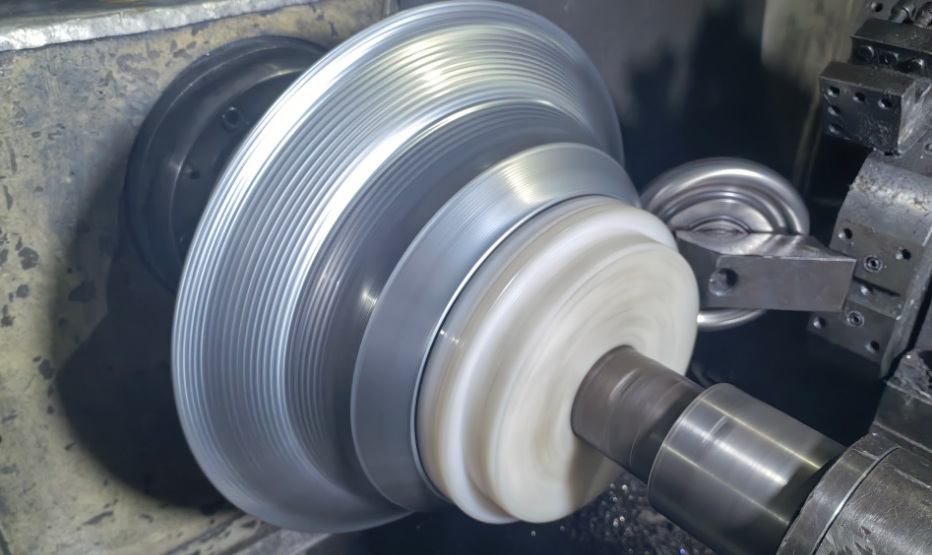
● Tube spinning
The blank of tube spinning is a pipe or tube. Pipe spinning is a local process to form the tube that involves flanging, necking and rolling.

● The difference
The sheet spinning needs the pressure from the tail stock to drive the rotation of the material sheet, and the tube spinning requires a hydraulic fixture to fix the tube.
3. Processing temperature
● Cold spinning
It is suitable for metals with soft and good plasticity at the room temperature, such as aluminum, copper and stainless steel.
● Hot spinning
Heating spinning can make hard and thick metal materials. Heating can make metal soft, the spin force is less. So hot spinning is applied in the aerospace materials that is hard to form by cold spinning.

Heating ways of hot spinning includes frequency heating and gas heating. Stainless steel and steel are usually heated by high frequency, while aluminium is heated by propane gas.
The materials must be required hot spinning include Aluminum 7075, Superalloy, Inconel 625, Inconel 718, Hardox, TC4.
4. Final shape
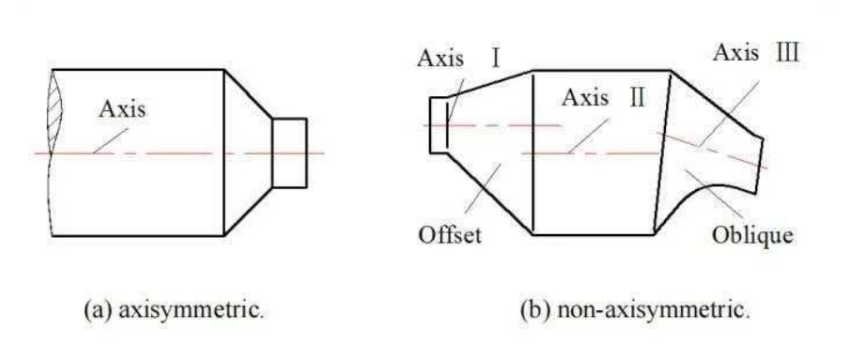
● Axisymmetric
Traditional spinning can only process symmetrical rotary parts.
● Non - axisymmetric
Spinning forming of non -asymmetric parts has been an important development direction of spinning technology in recent years. Although traditional spinning mainly focuses on rotary symmetrical parts , with the development of numerical control technology and multi-axis linkage equipment, it has been able to effectively meet the forming requirements of asymmetric structures (such as conical, variable cross-section, eccentric, inclined and polygonal cross-section).
Spinning forming of asymmetric parts has broken through the boundaries of traditional processes, its advantages are significant, especially demonstrating irreplaceable value in scenarios requiring high precision, high strength and lightweight.
Metal spining machine
1. Mechanical principles
● Blank rotating
The material sheet needs to be fixed on the mold and rotate along with the spindle.
● Roller movement
The roler needs to be constantly adjusted its position to control the forming path.
2. Machine construction
The structure of a metal spinning machine is very similar to that of a lathe.
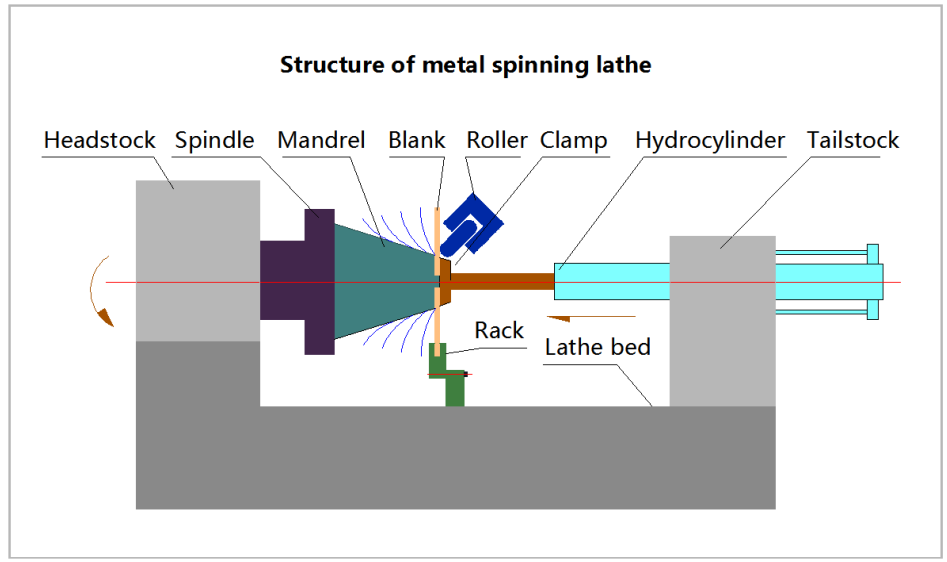
● Headstock
Headstock is Installed the spindle and motor to drive the mandrel to rotate.
● Tailstock
The tailstock is used to install the air cylinder and control the forward and backward movement of the clamping. During operation, the cylinder needs to move forward to provide clamping pressure to the tail top, and when the spin forming is completed, the air cylinder needs to move backward to facilitate the demolding of the product.
● Roller mounting
The control of the movement trajectory of the roller is the key to spinning forming. Manual spinning controls the movement path of roller by fixing pins at different positions on the roller mounting. CNC spinning can use CNC programming to control the movement trajectory of the tool path.
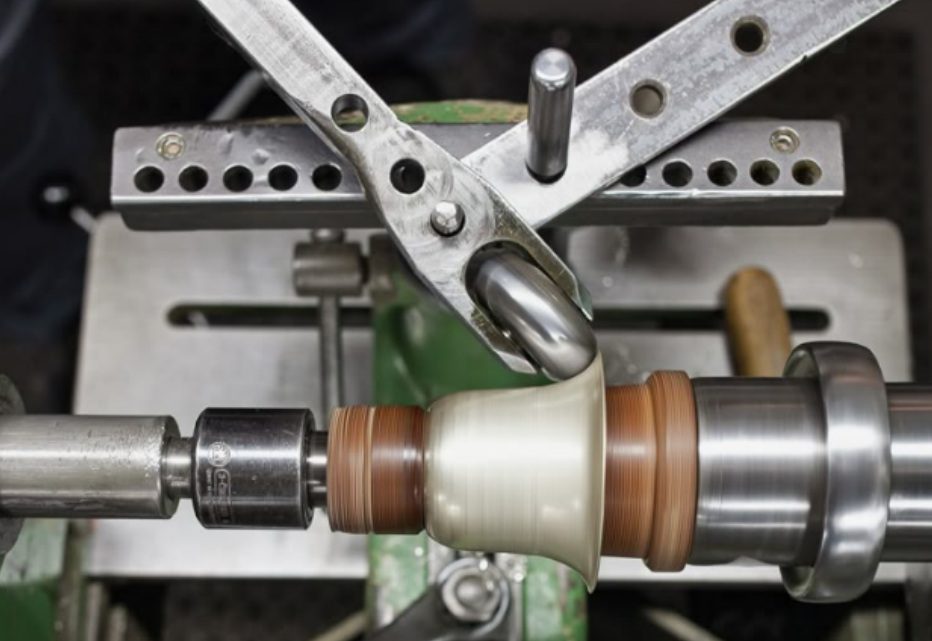
3. Manual spining lathe
Manual metal spinning lathe is simple and cheap, it is mainly composed of headstock, tailstock, spindle, air pressure cylinder, lathe bed. The price of hand spinning mahine is about 1200 dollers - 2200 dollars.

4. CNC metal spinning machine>

With the development of CNC metal spinning machine tools, hand spinning is reduced and replaced by CNC, CNC metal spinning machine tool can output stronger spinning force and control the accuracy easily. The basic machine structure is similar with CNC turning. the difference is CNC metal spinning machine needs stronger spinning force and quicker feed speed than CNC turning, so the motor, guide rail and lead screw of CNC metal spinning machine is bigger than CNC turning lathe.
● Machine cost and price
CNC metal spinning machines have many types, the light-duty machine is about 4500 dollar, the heay-duty is more expensive, such as the 800 double roller that can process 800mm blank diameter, the thickness of stainless steel can meet 3mm, the price is about 48,000 dollers. Double roller is more expensive than single roller, heavy duty is more expensive than light duty, the specification of CNC metal spinning lathe is bigger, the machine cost is more expensive.
● Single roller and double roller

CNC metal spinning machine have single roller and double roller, double roller works more balance than single roller. Thinning rate of double roller is bigger than single roller as the pull and press force of double roller is biger, but the accuracy of metal spun products is better that is made by double roller.

● The function of CNC metal spinning machine components
▷ Spindle motor power : spindle force
▷ Axis motor power and leading screw specification : spinning roller force
▷ Hydraulic pressure of tailstock cylinder : friction force of sheet
Harder, thicker and bigger diameter needs heavy duty metal spinning machines, it needs stronger spindle force and spinning roller force to deform.
Softer, thinner and little diameter needs light duty metal spinning machine, it works more fast with a high spindle speed and feed speed.
● CNC spining path and parameter>
▷ Spindle speed : spindle speed is higher, the thinning rate is less .the surface is more smooth.
▷ Feed speed : the feed speed is high, the thinning rate is less, the surface is worse.
▷ The radius of roller : the radius is bigger, the thinning rate is less, but the edge of sheet is wrinkling in the spinning. the radius is little, the thinning rate is bigger, the bottom (near the mold surface )of the sheet is easy to break in the spinning.
▷ CNC spinning path : this is most important factor in the spinning, right CNC spinning path can form the sheet with a good surface and precision.
● CNC spinning tool
▷ CNC spinning roller : metal forming tool.
▷ Turning tool : a tool use to trim the edge.
▷ Air pressure device : It help metal spinning product to remove.
▷ Blank rack : it is used to control and put on the blank sheet in the center of spindle.
▷ Heating equipment : high frequency heating equipment and gas heating tanks.
▷Tube spinning fixture : it is used in tube spinning to hold the tube tightly .
Spinning technology >>
1. Spinning forming methods
● Conventional VS Shearing
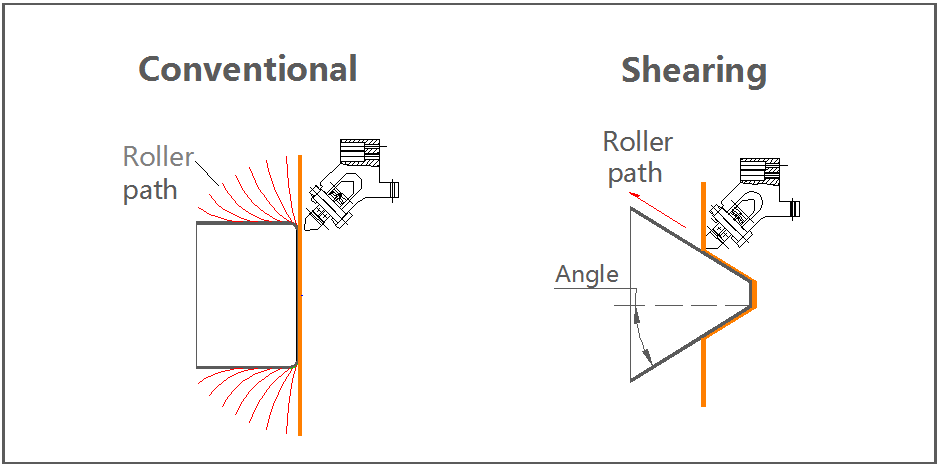
Conventional spinning and shear spinning are two essentially different spinning processes. The core difference lies in whether causes a significant change in the wall thickness of the blank. According to the movement trajectory of the forming tool path, conventional spinning can also be called multi-path spinning, and shear spinning can also be called single-path spinning.
▷ Conventional spinning : Conventional spinning mainly changes the shape while the wall thickness remains basically unchanged. The wall thickness change in conventional spinning is mainly due to the slight thinning of the material caused by the stretching of the roller.
▷ Shearing spinning : Shear spinning significantly reduces the wall thickness during the forming process. The thinning is due to the extrusion of the raw material by the roller and the mold, and the defomation is mainly shearing thinning.
● Necking, Expanding, Rolling and Flanging
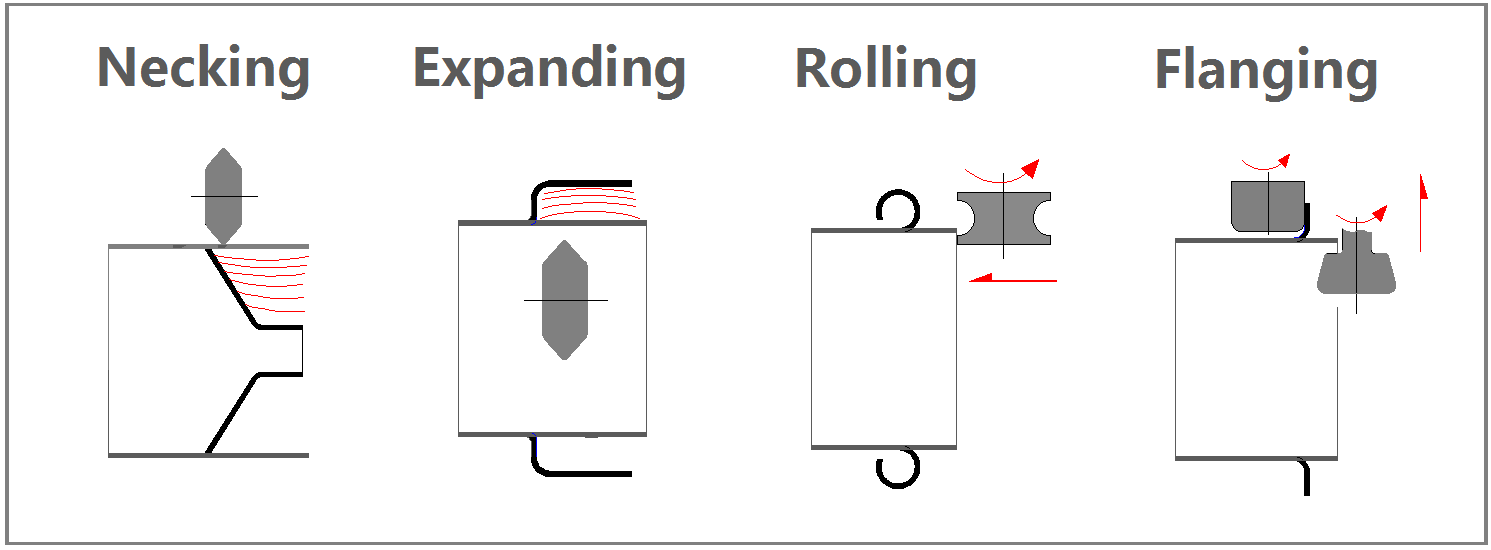
Necking, expanding, rolling and flanging are used in tube spinning commonly, many metal spinning products are used necking and expanding, such as automobile part three-way catalyst and air spring shell, metal vase, head, hydrogen and oxygen tank. Rolling is used to improve the strength and make the edge smooth, flanging is used to assemble different part together by screw, flanging forming is a good ways instead of traditional welding flanging, it reduces the welding and polishing cost.
● Flow forming

Flow forming is a precision forming process in which the cylinder billet is installed on the mandrel of the spinning machine. The mandrel and billet rotate synchronically driven by the spindle, while the rotating wheel contacts the billet and feeds along the mandrel axially, resulting in plastic deformation of the billet, resulting in wall thickness reduction, diameter increase and length increase of the cylinder. This process is mostly used for processing thin-walled hollow rotary parts, such as rocket engine shells, hydraulic cylinders and high pressure vessels.
2 . Thinning rate
Blank sheet will be thinning after metal spinning. Hand spinning thinning rate is 10% -25%, the CNC spinning thinning rate is 20%-50%, because CNC spinning can make work piece produce shear deformation.
Cylinder has conventional spinning and shearing spinning, Common the depth valve of cylinder is big, the thinning rate is big, when the depth is over 200mm, the thinning rate can meet 50%, thinning rate of deep cylinder is biggest .The cone is shearing spinning, the actual thickness after spinning = sin Aº * blank thickness. Necking will increase the thickness and expanding will reduce the thickness. Necking will increase the thickness and expanding will reduce the thickness.
3. Shape
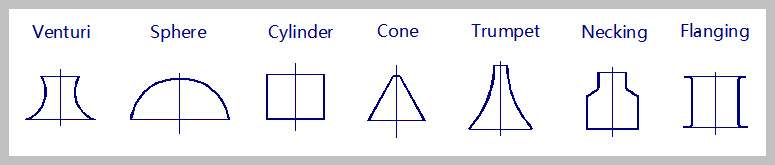
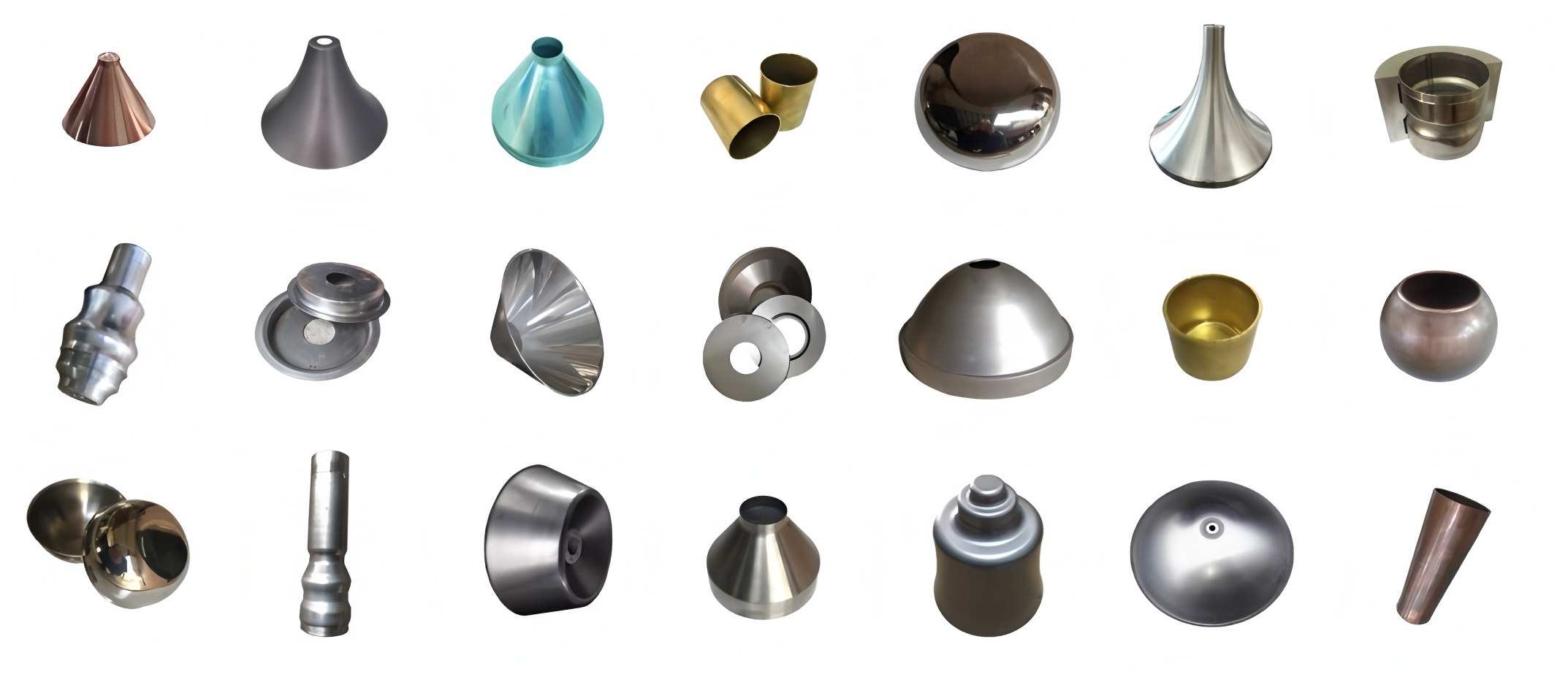
Metal spinning form tube and sheet to different shape, such as venturi, sphere, cylinder, cone, funnel, trumpet, flanging, compare to deep drawing, the necking and tube spinning can make the shell into more shape base on the following of shape.
4. Tolerance>
Metal spinning accuracy is related to the tensile strength of structure, the accuracy of CNC metal spinning machine tool, process temperature, material performance, spinning path, mold design. Metal spinning diameter and height tolerance can meet 0.1mm at most. There is many ways to control the metal spun accuracy in the production.
● Mold and roller runout : it must control within 0.03mm, otherwise the spinning gap is not stable.
● Process temperature : metal spinning is a cold working can make the workpiece rise the temperature, to control the process temperature can improve the accuracy.
● Spinning path : using the right spinning path can make the production accuracy stably.
● Structure : the strength of the structure design can reduce the spring back effect the accuracy.
● Material : different material has different spring back performance, the springback is less, the accuracy is better.
Metal spinning needs mandrel (it is also called mold), the exterior curve of mandrel is same with the interior curve of metal spun product. Mandrel function is to support the sheet or tube, the surface of mandrel is smooth, the exterior of metal spun products is smooth. Mandrel needs hard steel and heating treatment to improve the surface hardness, if the hardness is not enough, the interior of metal spun product will be scratches when it spin the stainless steel or harder metal.

Roller hardness meet HRC-58, the roller wear quickly when it spin the stainless steel or harder metal, commonly many factory use electroplate harder metal on the roller surface after heating treatment to achieve the higher hardness. The rollr hardness is higher, the exterior of metal spun product is smoother.
Materials >>
Main bank metal classify tube and sheet, the other blank shell made by Deep drawing and casting can be used in metal spinning as well. Metal spinning is divided into tube spinning and sheet spinning according to the blank metal tube and sheet.
1.Material shape

2.Sheet performance
Sheet is classified cold rolling sheet and hot rolling sheet. The hardness and tensile strength of cold rolling sheet is higher than hot rolling sheet. The thickness cold rolling sheet is less than 5mm, if the thickness is bigger than 5mm, it is the hot rolling sheet. Cold rolling have better ductility, because hot rolling have more has porosity and trachoma.
3.Tube performance
Tube is classified seamless tube and welding tube. Thick tube is seamless tube, the thin tube is welding tube. Stainless steel welding tube should be welded by SU304 DDQ, otherwise tube will break after spinning.
4. Specification
Sheet : 1m*2m, 1.24m*2.44m, 1.5m*3.0m
Tube : It needs to make mold to custom, the stainless steel tube must be DDQ standard, it can be made by deep drawing.
5. Common blank metal types
Aluminum : 1060 /1070/ 1100/3003 / 5052 / 5251 /5083/ 6061
Titanium : TA1 TA2
Steel : SPCC / DC03 / DC04 / Q235/ Q275/ Q345
Silver : IC-Ag99.99
Copper : C10 100 / T1
Brass : H62 / H65
Stainless steel : 201 / 304 / 316 / 310
Aluminium and steel are easy to spin as the ductility is good, TA1, TA2, H62,H65 need to heat to reduce spring back, the stainless steel is hard to spin, it needs more spinning force.
6. Special blank metal types
Hardox 400 GH3044 SUS310 SUS630 Inconel 718 Inconel 625 TC4 A286 Hastelloy
Aluminum 2024/2A12/7075/5A06 (aerospace aluminium) Supperalloy ( high temperature alloy )
Except the aerospace aluminium series, other metal have higher tensile strength and hardness than Stainless steel 304, it needs to spin with heating.
Application >>

Metal spinning is wide applied in different industries, metal spinning can process complex shape, thicker and bigger blank sheet, high accuracy and strength, these advantages make metal spinning play a irreplaceable role in the manufacturing.
● Tensile strength : these components need to bear force such as oxygen tanks ,pressure container and bottle.
● Complex shape forming capacity : it applied in decoration, such as lampshade, table base.
● Large dimension : it applied in industrial fan, industrial funnel, firebowl.
● Special metal : the special metal material are working in a rugged environment such as high temperature, vibration, high speed and bearing the force. Special metal and heating metal spinning is better choice for military and aerospace industries.
Metal spun products >>
1. Lampshade
lamp shadow is the most prolific product produced by metal spinning, most of lampshade materials is used steel and aluminum, these two material is soft to spin, many Indian and Vietnam factory make lampshade shell by hand spinning.

2. Tableware and vase
Stainless steel tableware, vase, bottle and pan can be made by metal spinning.

3. Auto parts
The air spinning shell, three-way catalyst, wheel are made by CNC metal spinning, the wheel CNC metal spinning machine is a hydraulic power spinning, metal spinning can improve the tensile strength of blank casting wheel and reduce the weight of wheel.

4. Industrial fan
The dimension of industrial fan is big, common the diameter of industrial fan is over 300mm. It need metal spinning to save mold cost, now no-mold metal spinning applied in industrial fan maturely .

5. Combustion chamber and nozzle
Combustion chamber, nozzle and fairing are the key components in the turbojet, the working temperature is very high, Nozzle working temperature can achieve 700ºC, it is used the Inconel 718 and Inconel 625 to make the nozzle, the combustion chamber working temperature can achieve 1600-2200ºC, it is used the superalloy to make the combustion chamber, supperalloy is also called high temperature alloy.
