

Metal spinning VS deep drawing - The difference
Metal Spinning> and deep drawing are two common metal forming processes, mainly used in the manufacture of rotary parts. However, there are significant differences in processing principles, mold structures, material utilization rates, and product performance.
Deep drawing vs metal spinning
Deep drawing can be processed in a hydroforming machine or a punching machine. The speed of hydraulic forming is slower and the stretching is deeper. The punching machine stretches faster and shallower.
Metal spinning is a plastic forming process that requires little or no cutting. Local pressure is applied to the rotating blank by a spinning roller, causing the blank to deform continuously point by point. It can simultaneously complete processes such as spinning, edge cutting and edge rolling on a spinning machine or CNC spinning lathe>.
1. Process principle
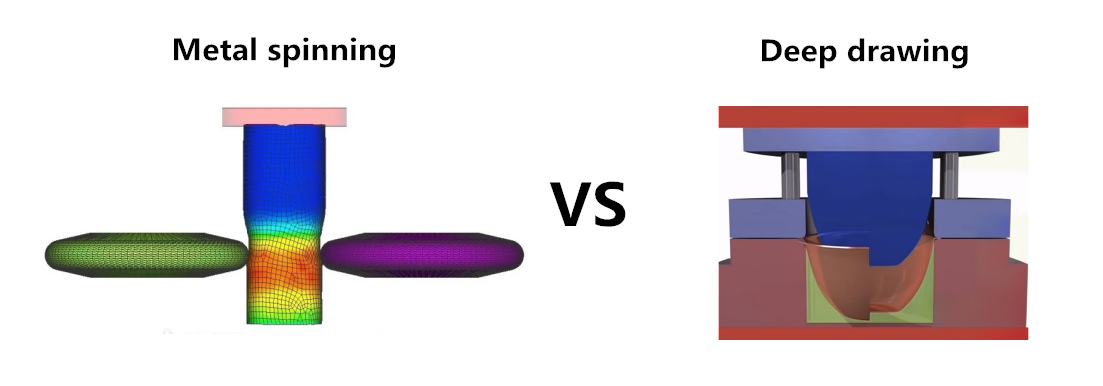
● Metal spinning : By moving the spinning wheel (tool wheel) along a predetermined trajectory , the rotating blank undergoes plastic deformation point by point to achieve shaping. The deformation is controlled by the path of the rotating wheel and belongs to local continuous deformation.
● Deep drawing : By using the fit of the punch and die , the flat blank is pulled into the die cavity as a whole. It belongs to integral one-time or step-by-step forming , and the deformation is controlled by the die gap.
2. Mold cost
Metal spinning only requires one mandrel (female die), without the need for a die. The die structure is simple, and the manufacturing cost is only 1/3 to 1/6 of the drawing die. Moreover, it can be adjusted and repaired by CNC metal spinning machine directly, it is more convenient .
Deep drawing and stamping require pairs of punches and dies . The molds are complex, costly, have a long manufacturing cycle, and are difficult to modify.
3. Process step
Spinning in one die can complete forming, trimming, rounding and bottom cutting, but deep drawing requires 4 to 5 dies for each process. The labor cost required is higher.
4. Production efficiency
Small volumes :Although the production time for each process of forming, trimming and rolling by metal spinning is longer, the time for adjusting the mold is shorter. It has obvious advantages in small-batch processing and production.
Large volumes :Although the processing time for each step of deep drawing and stamping is shorter, more molds need to be debugged, and the installation and debugging time of the molds is longer. So it has more advantages when dealing with large quantities.
5. Thinning rate
The thinning rate of metal spinning and stretching can reach up to 20-70% at most, but the thinning rate of deep drawing forming is 10-15%.
6. Blank diameter
For products of the same shape, a larger sheet diameter is required for deep drawing, and a blank holder is needed for deep drawing, resulting in a low material utilization rate. Metal spinning does not require edge material, but the thinning is greater, so spinning needs thicker raw materials.
7. Forming shape
Spinning can only form rotary parts, but deep drawing and can produce more irregular-shaped parts. In simple terms, spinning can produce round shape, deep drawing can produce round, square, or any other shape.
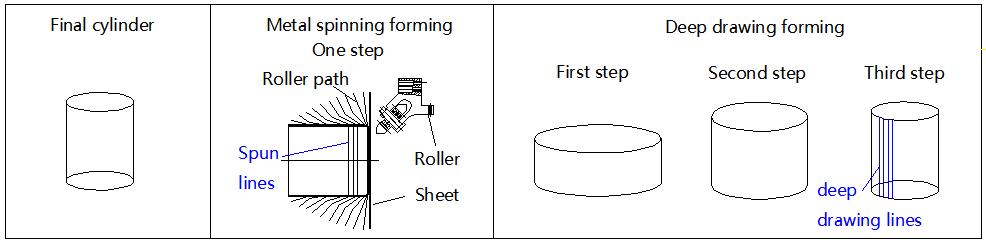
When the rotary body parts exceed a certain height, spinning can be formed in one go, but stretching requires 2 to 3 distributions to be formed.
8. Finishing surface
Both the spinning and deep drawing surfaces are very smooth. Judging from the surface texture, the deep drawing line is vertical, while the spinning line is round. In terms of polishing cost, the polishing cost of the deep drawing is lower.
Overall, the metal spinning surface > is still slightly worse than that of deep drawing.
9. Process thickness
Spinning is the process of changing the shape of a material by applying pressure at a single point, while deep drawing changes the shape of the material as a whole. So the forming force required for deep drawing is greater. When the material is relatively thin, such as stainless steel less than 1.5mm, the ability to form products by stretching has more advantages. However, when the thickness is very thick or the metal material is very hard, deep drawing is limited by deep drawing or the material's ductility and cannot form. But spinning can enhance the material's ductility by heating and reduce the forming force. Therefore, spinning has more advantages in thick and hard materials.
10. Springback and interior stress
The springback and internal stress during spinning are greater. Moreover, the interior stress distributed is different. When you make local openings on the same shape of deep drawing and spun products, the shape deformation of the spun products is greater.
11. Tolerance
Due to the bigger interior stress, when the product is demolded from the mold, the interior stress of the spun product will cause the mouth of the product to become elliptical. So the precision of spinning is not as good as that of stretching.
12. Mechanical property
During the spinning forming process, the extrusion of the raw material by the roller is a single-point contact, which will cause grain refinement and enhance the tensile strength and hardness of the product. When deep drawing is stretched multiple times and the interior stress is high, if the workpiece is not subjected to high-frequency stress relief, it is prone to cracking along the direction of the stretching texture after being left for a period of time.
13. Application
Deep drawing products are mainly applied in the processing of large quantities of electronic products, home furnishings, household appliances, etc., while metal spinning is mainly used in customized home and household appliances, as well as core components of automobiles, aerospace, and mechanical equipment.
The choice of stretching forming is generally for lower processing unit prices and higher production efficiency, while the choice of spinning is usually for lower mold costs, and at the same time, spun products have better mechanical properties.
NEXT:
None
Recommended
- -Metal spinning machine-performance, types, price and problem
2026-09-29 - -Metal spinning guide -The factors effect the spin forming
2026-06-25 - -Spin forming principle-CNC metal spinning technology
2026-02-22 - -What is CNC metal spinning machine tool
2024-08-15 - -Metal spinning VS deep drawing - The difference
2026-03-08 - -Aerospace components-Precision manufacturing of CNC spinning
2025-01-29 - -Metal spun products - what product spin forming can do
2025-01-24 - -How to design a CNC metal spinning mold | mandrel
2024-04-12 - -Metal spinning materials
2024-04-14 - -Metal spinning process and technology
2024-11-30